
UPDATED OCTOBER 28, 2026
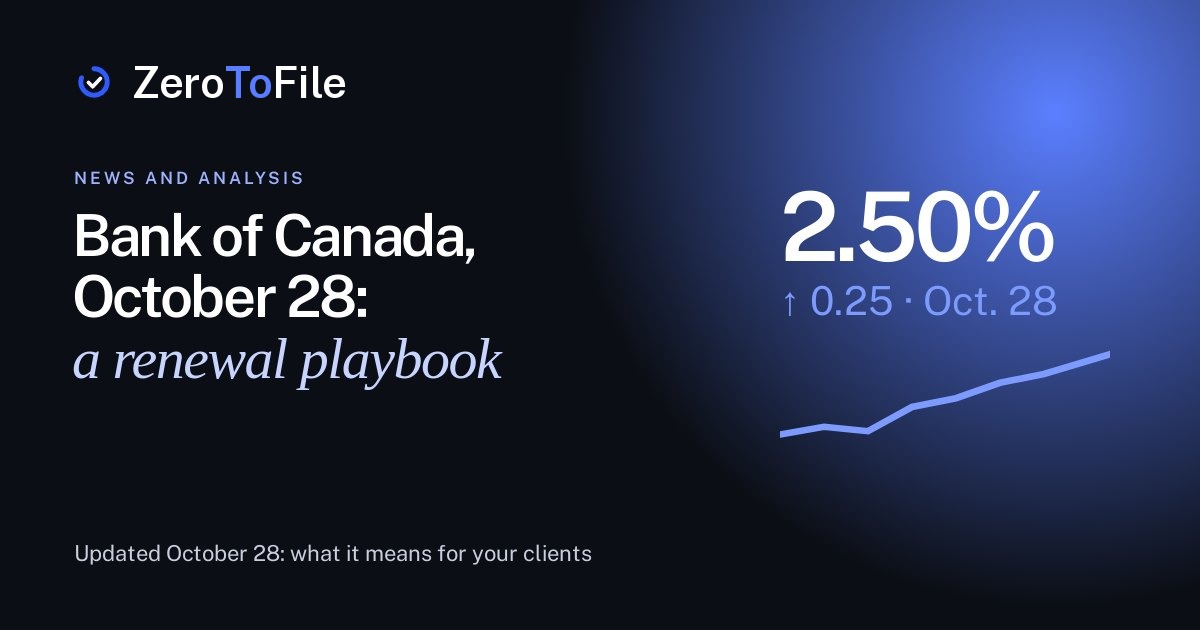
The decision: the Bank of Canada raised its rate to 2.5%
What happened: on October 28, the Bank of Canada raised its policy rate by 0.25 point, from 2.25% to 2.5%. It is the first hike since July 2023. The Bank said inflation is “higher and more persistent” than it expected in July, and that it moved to stop high energy prices from spreading to other prices. It also warned there “could be a need to increase the policy rate further.” The next decision is December 9.
- Rates set by the Bank: policy rate 2.5%, Bank Rate 2.75%, deposit rate 2.45%.
- Inflation outlook: the Bank now expects inflation to stay around 3% through much of 2027.
- Prime rate: 4.45% before the decision. If the banks pass on the full 0.25 point, as they usually do within days, prime moves to 4.70%. At the time of writing, the big banks had not yet published their new prime. Check each lender’s posted prime before quoting a client.
- Variable payments: Ratehub estimates that a variable rate going from 3.45% to 3.7% adds about $82 a month ($984 a year) on an average-priced home bought with 10% down.
First reactions from lenders’ economists
- Desjardins (Royce Mendes): calls another hike in December “a coin flip” and expects the next and final increase in January 2027.
- CIBC (Andrew Grantham): expects a hold in December, one more hike in January, and a policy rate no higher than 2.75%.
- Markets: traders put the odds of a second hike on December 9 at roughly 4 in 10, according to Bloomberg.
What to do with your clients now
- Variable-rate clients with adjustable payments: send them the new payment as soon as their lender confirms the new prime.
- Variable-rate clients with fixed payments: check who is now close to their trigger rate.
- Renewals in the next 120 days: secure rate holds now. Another hike is possible in December or January.
Our preview from October 23 follows below, unchanged, for reference.
Before the decision: our October 23 preview
The short answer: the Bank of Canada announces its next decision on Wednesday, October 28, 2026, at 9:45 a.m. ET. The policy rate is 2.25%. Markets were pricing roughly 80% odds of a quarter-point hike after September’s inflation came in at 3.1%, but economists are split. Fixed rates have already risen with bond yields, whatever the Bank does. This week, review every renewal coming due in the next four months and every variable-rate client, and secure rate holds where they make sense.
Where things stand this week
- Policy rate: 2.25%, held on September 2. Prime is 4.45%.
- Inflation: 3.1% in September, up from 3.0% in August, driven mostly by gasoline. Excluding gas, inflation was 2.2%.
- Jobs: Canada lost 68,000 jobs in September and unemployment rose to 6.5%. That is the main argument for holding.
- Market odds: about 80% for a 0.25-point hike, according to Reuters as cited by MoneySense on October 22. Desjardins expects a hike; RBC expects a hold through the end of 2026.
- Bond yields: the 5-year Government of Canada yield climbed from about 2.6% to above 3.6% and topped 3.7% on September 28.
Fixed rates have already moved
Fixed mortgage rates follow bond yields, not the overnight rate, and lenders have repriced. All six big banks raised fixed rates between early September and mid-October:
| Lender | Move reported |
|---|---|
| BMO (Oct. 7) | Standard 5-year fixed up 0.20 to 5.14%; special 3-year fixed up 0.20 to 4.94%; insured 5-year up 0.15 to 4.99% |
| RBC (week of Oct. 6) | Fixed terms up 0.10 to 0.20; smaller discount on new 5-year variable |
| Scotiabank | 2-year fixed raised to 5.14% |
| CIBC | Most terms up about 0.20 |
| TD | Several terms up as much as 0.40 to 0.50 since early September |
| National Bank | Mostly up 0.10 to 0.30 |
These are posted and advertised bank rates, not broker channel rates. The lowest advertised 3- and 5-year fixed rates were around 4.34% on October 22, and the lowest variable around 3.43%.
Two scenarios for October 28
If the Bank holds at 2.25%
Variable rates stay where they are until at least December 9. Fixed rates do not automatically fall: they stay tied to bond yields. Expect the December 9 meeting to become the next deadline in clients’ minds.
If the Bank hikes to 2.50%
Prime moves to 4.70% within days. The lowest variable rates move to about 3.7%. Clients with adjustable payments see higher payments right away. Clients with fixed payments keep the same payment, but more of it goes to interest. Check who is getting close to their trigger rate.
Your call list for this week
- Renewals in the next 120 days. Many lenders hold a rate for around 90 to 120 days. A hold costs the client nothing if rates fall, and it protects them if fixed rates keep climbing.
- Variable-rate clients. Prepare a one-line answer for each: what a 0.25-point hike does to their payment, and whether converting to fixed makes sense for them.
- Pre-approvals with expiring holds. Buyers still searching may lose a better rate if their hold lapses this month.
- Clients who could switch at renewal. A straight switch (same amount, same amortization) is no longer stress-tested at federally regulated lenders, so more clients can shop their renewal. Start the paperwork early.
Why renewals matter more than the headline
The Bank of Canada estimated in 2025 that about 60% of mortgages renewing in 2025 and 2026 would see a payment increase. For five-year fixed borrowers, the average increase was around 15% to 20%. With fixed rates moving up again this fall, clients renewing in the next few months will feel it. The brokers who call first, with numbers ready, keep those clients.
Get the paperwork moving now
A switch at renewal needs the current mortgage statement, a recent property tax bill, updated income documents and proof of home insurance. Ask for everything in one request, track what is missing, and you will be ready to submit the moment the client decides. See our mortgage document checklist for the full list.
Frequently asked questions
When is the next Bank of Canada rate decision?
Wednesday, December 9, 2026. On October 28 the Bank raised its policy rate to 2.5% and said a further increase could be needed.
Will fixed mortgage rates go down if the Bank of Canada holds?
Not necessarily. Fixed rates follow Government of Canada bond yields, and the 5-year yield has climbed above 3.6% since the summer. As long as yields stay there, fixed rates are unlikely to fall much, whatever the Bank decides.
How does the October 28 hike affect variable-rate clients?
Prime is expected to rise by the same 0.25 point, from 4.45% to 4.70%, once each lender confirms its new prime. Clients with adjustable payments will see their payment rise; clients with fixed payments will see more of each payment go to interest. Ratehub estimates about $82 more a month on an average-priced home with 10% down.
Do clients need a stress test to switch lenders at renewal?
Not for a straight switch, meaning same amount and same amortization. OSFI removed the stress test for uninsured straight switches at federally regulated lenders from November 21, 2024, and the federal government extended the relief to insurable mortgages. The new lender still qualifies the client at the contract rate.
Sources
- Bank of Canada: Bank of Canada raises the policy rate by 25 basis points to 2½% (Oct. 28, 2026)
- The Globe and Mail: Live updates, Bank of Canada raises key interest rate to 2.5% (Oct. 28, 2026)
- BNN Bloomberg: Bank of Canada raises key interest rate, says another hike possible (Oct. 28, 2026)
- MoneySense: Bank of Canada interest rate forecast, what to expect on October 28 (Oct. 22, 2026)
- money.ca: All six big banks raised fixed mortgage rates (Oct. 11, 2026)
- Canadian Mortgage Trends: Fixed mortgage rates continue to climb (Oct. 1, 2026)
- Bank of Canada: How will mortgage payments change at renewal? An updated analysis (July 2025)
- Ratehub: OSFI drops stress test requirement for mortgage renewal switches
Rates and market odds are as reported on the dates shown and change daily. This article is general information for mortgage professionals, not financial advice.
See it on a real file: Same file, two very different weeks